

Posts tagged mindset
Here Are 5 Most Interesting and Best Happy Human Discoveries – v52

Enjoy the latest release (v52) of the “What’s Interesting?” series, which features my most recent finds that inform, inspire, and connect to organizing and life balance. These unique, wonderfully human discoveries reflect this month’s blog theme.

You are an engaged, vibrant, and generous group. I am deeply grateful for your ongoing presence, positive energy, and contributions to this community. I look forward to your participation and further contributions to the collection I’ve sourced.

What do you find interesting?


What’s Interesting? – 5 Best Happy Human Discoveries

1. Interesting Workshop – Human Organizing

Are you feeling burdened and overwhelmed by clutter or disorganization? If you answered, “yes,” you’re not alone.

Research shows that cluttered spaces often contribute to stress, fatigue, anxiety, and even depression. But there’s good news—help is here!

If you’re ready to explore a kind, compassionate, and more human approach to decluttering and organizing, you’ll love this! Join me, Linda Samuels, Professional Organizer, for an engaging and transformative workshop7 Easy Ways to Practice Mindful Organizing.

One workshop with your choice of two dates:

  • December 2nd at 7:00-8:00pm Eastern or

  • December 4th at Noon-1:00pm Eastern

By the end of the one-hour Zoom workshop, you’ll have strategies for immediate change. You will:

  • Gain valuable insights about gentle organizing.

  • Learn seven mindful organizing practices.

  • Receive personalized support.

This is a great opportunity to prepare for the new year. When you bring more mindfulness and purpose to organizing, you can create calm, clarity, and breathing room. Reserve your spot today!


2. Interesting Resource – Human Helping
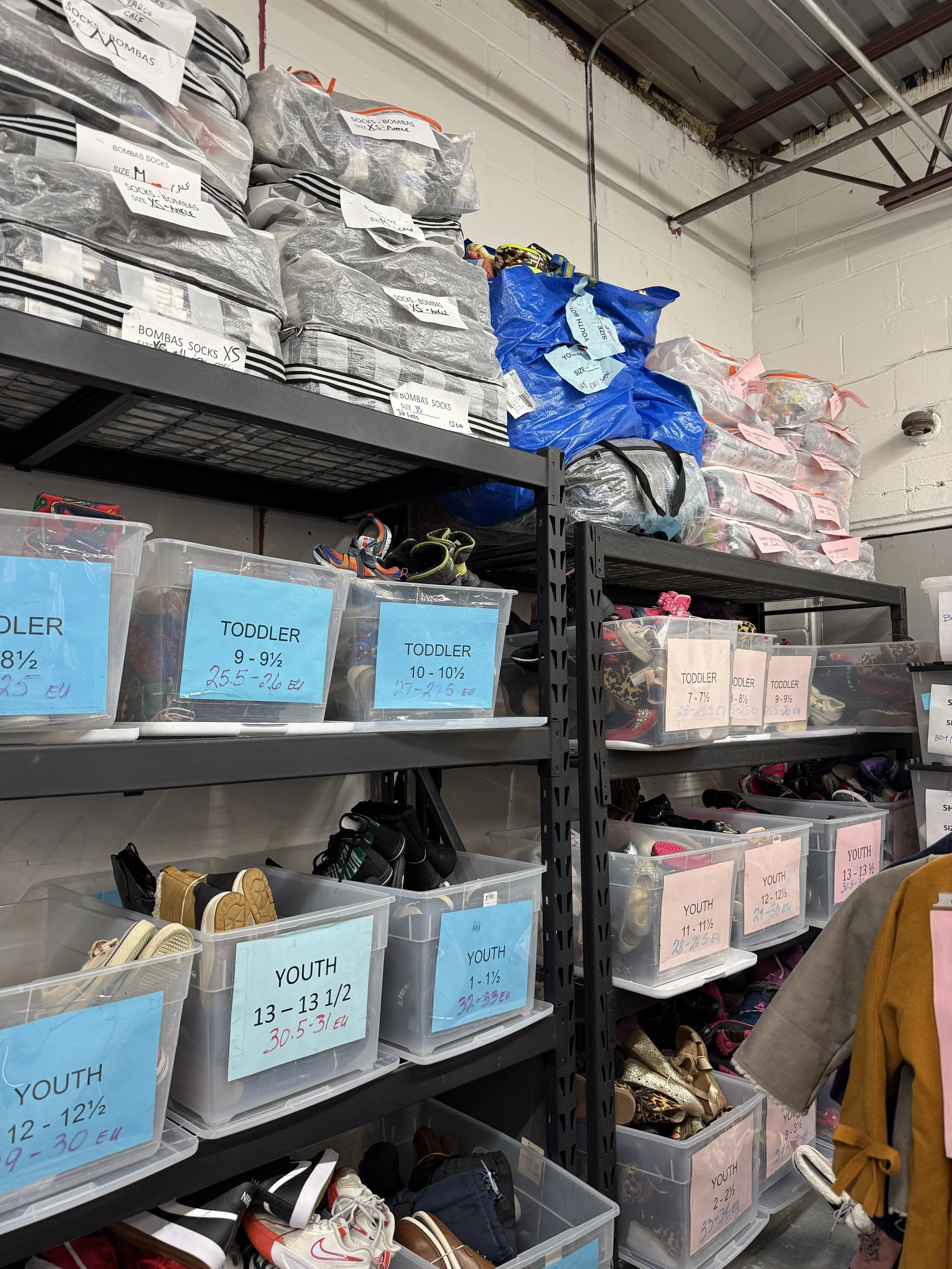
Last month, I went on a field trip with some of my Westchester NAPO Neighborhood group organizing colleagues to The Sharing Shelf in Port Chester, NY.

This remarkable nonprofit provides clothing, school supplies, and other essential necessities, including new socks, shoes, underwear, and hygiene products, to children and teens in Westchester County.

They offer a Wardrobe Pack, which includes a week’s worth of seasonally appropriate clothing tailored to a child’s needs. They also have a Teen Boutique, a free store where teens can “shop and select their own clothing with privacy and respect.”

The Sharing Shelf reports that children facing clothing insecurity “often miss school.” The research shows that “Nearly 14% of Westchester children are chronically absent from school, and clothing is one critical cause.”

Donations of new or gently used clothing in all sizes, from newborn to adult XXL, are accepted. Items should be clean and in good condition. Pieces that are stained or damaged will be sent to textile recycling. The Sharing Shelf has a Target registry and an Amazon wishlist, so you can order items they need.

When you bring more mindfulness and purpose to organizing, you can create calm, clarity, and breathing room.
— Linda Samuels, CPO-CD®, CVOP™


3. Interesting Read – Human Doing

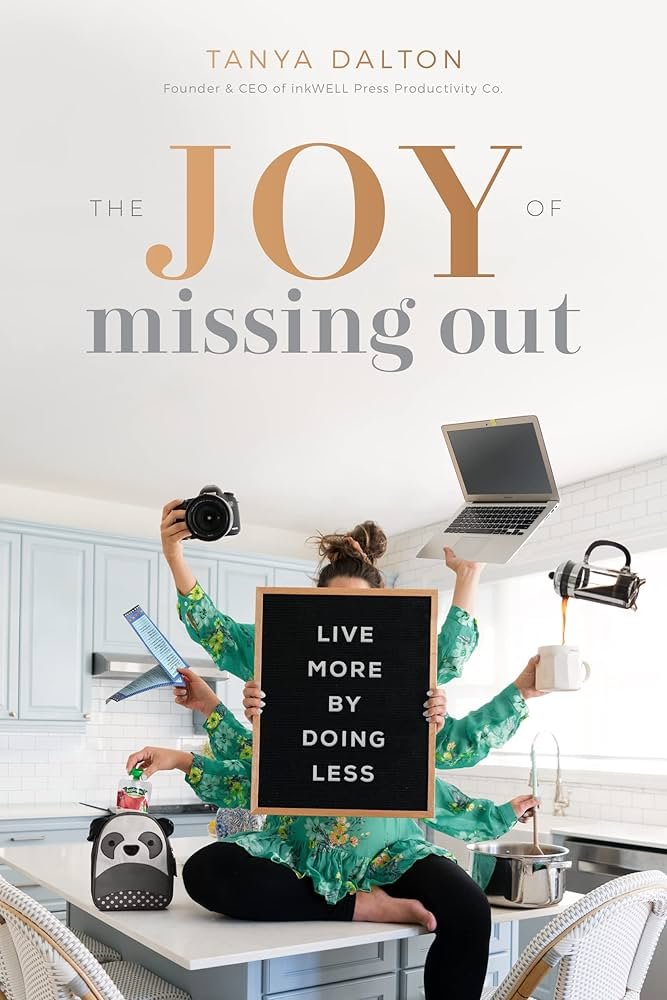
You’ve probably heard of FOMO, the fear of missing out. Have you heard of the opposite, JOMO, which is the joy of missing out?

In The Joy of Missing Out – Living More by Doing Less, Tanya Dalton, a productivity expert, author, and speaker, discusses the overwhelm many women experience due to:

  • Striving to do too much

  • Inability to say no

  • Being unclear about priorities

  • Not knowing where to start

Tanya encourages a mindset shift, saying, “We have to begin finding the joy of missing out on that extra noise in our lives and instead find happiness in a life centered around what’s truly important to us.” She encourages us to “stop the glorification of busy” and to stop worrying that we’re not enough or are not doing enough.

In this four-step liveWELL Method, which Tanya developed for herself, she now uses it to help others create a blueprint for reclaiming their time and living the life they desire. The steps are:

  • Discovery – Identify your unique purpose, life priorities, and North Star.

  • Clarity – Align your projects and tasks with your goals and priorities.

  • Simplicity – Design systems that make your life easier, enabling you to manage it with less effort.

  • Harmony – Build upon the first three steps to create harmony and the life you love.

Tanya says, “We need to discover the priorities that are unique to us, but first we have to take hold of the truth: we must be willing to not have it all.”

We have to begin finding the joy of missing out on that extra noise in our lives and instead find happiness in a life centered around what’s truly important to us.
— Tanya Dalton

4. Interesting Product – Human Curating
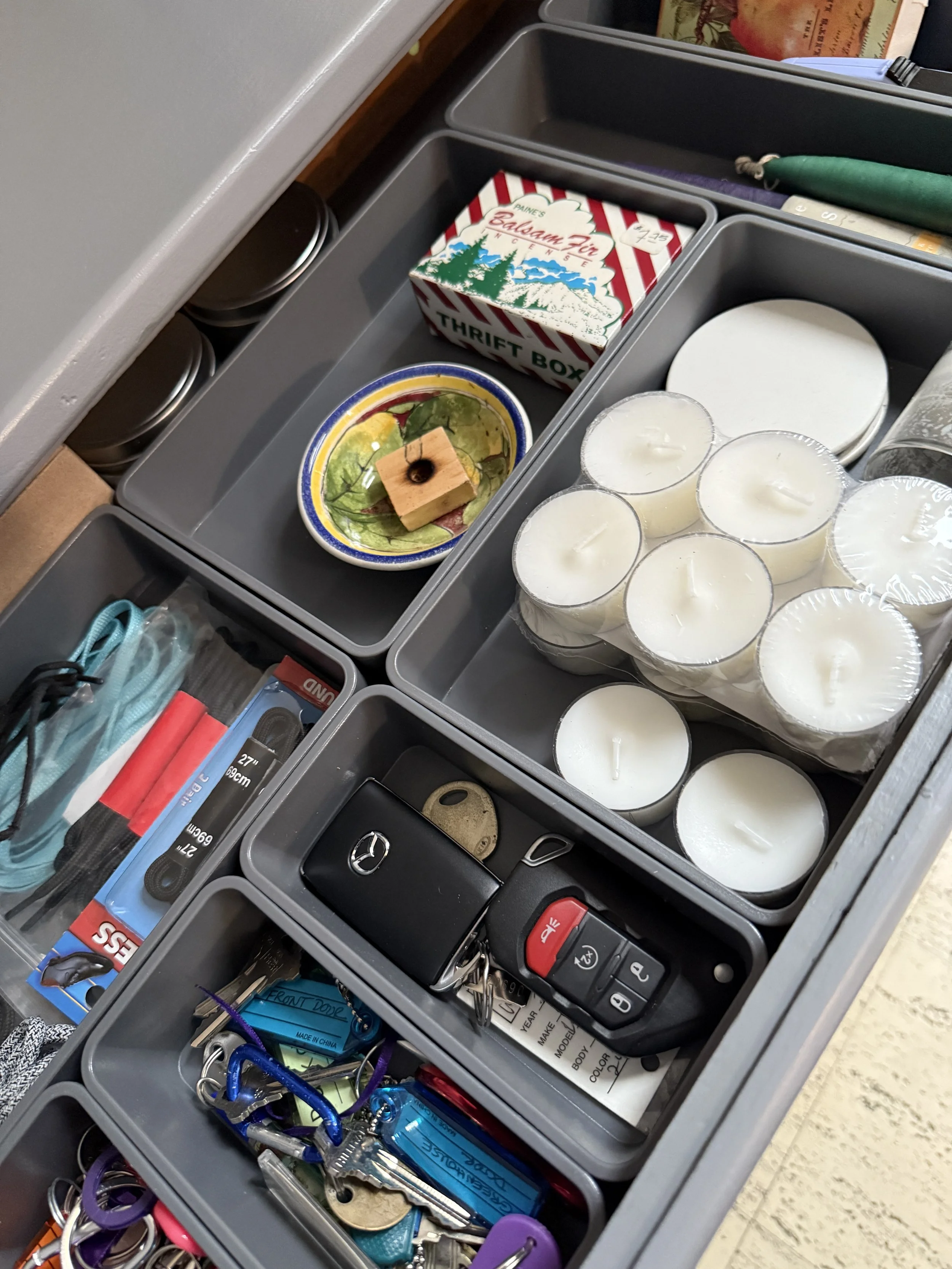
One of my favorite things to organize is cabinet drawers. The more chaotic, the better. A disorganized drawer presents an opportunity to edit, organize, and create order. Why does it matter?

Imagine the feeling of opening a drawer and finding exactly what you need right when you need it. No more searching or stress. It’s a good feeling, and a time-saver, too.

Recently, my husband asked me for drawer organizers and a design for his desk drawer. I recommended these lovely gray open bins, Terra Recycled Drawer Organizers from The Container Store. They also come in white and a variety of sizes. I liked them so much that I purchased more to organize a drawer in our shoe cabinet.


5. Interesting Thought – Human Experiencing
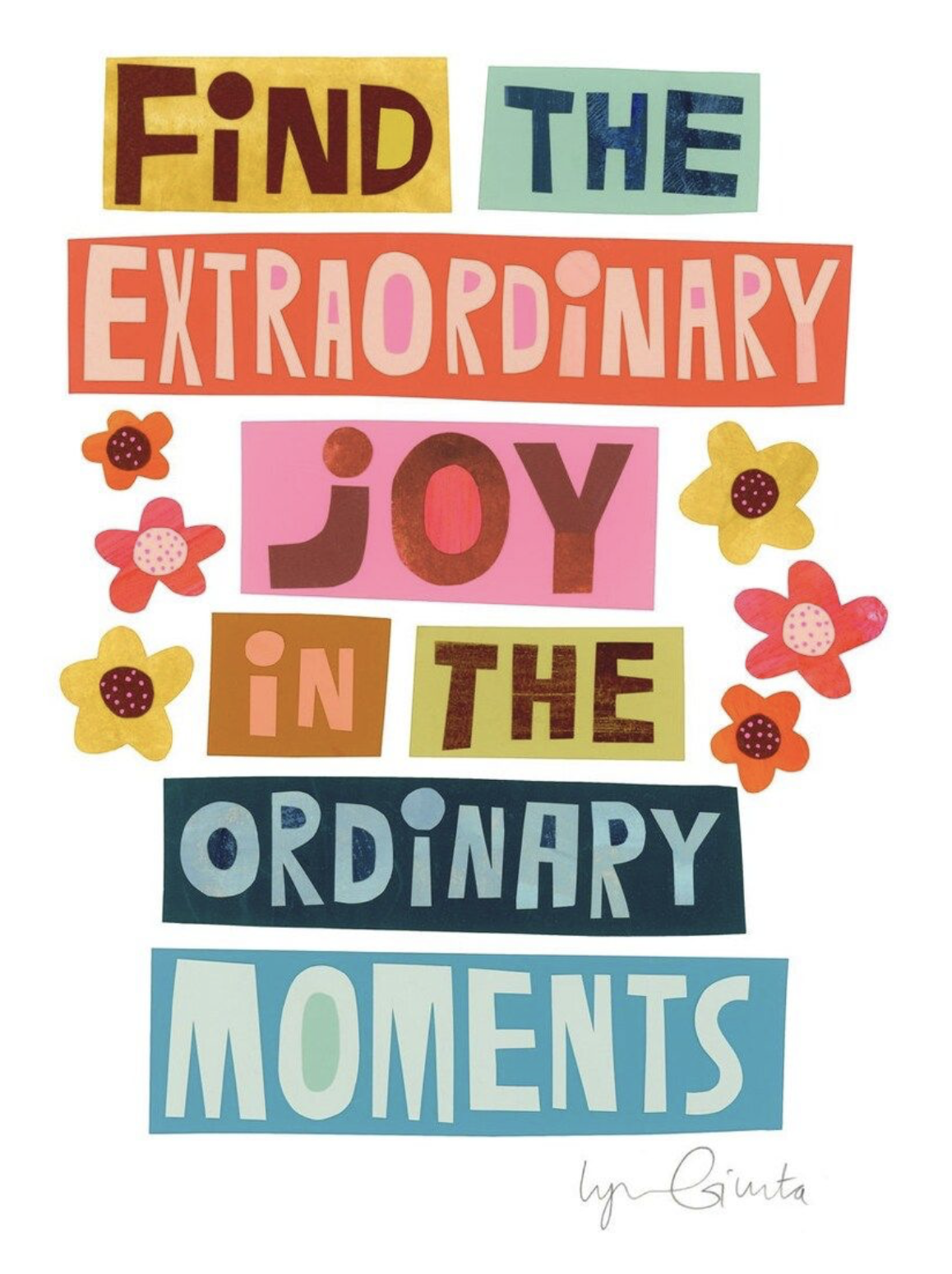
Let’s face it. Life can be stressful and chaotic. You make plans, and things change. You start a project, and something goes wrong. Your schedule is packed with little or no downtime.

However, even knowing this, you can experience joy in everyday moments. Let yourself be open to those tiny, ordinary moments. They can replenish your reserves, reinforce your gratitude wells, and help you feel more alive in a uniquely human way.

What can these joy-infused moments feel or look like? There are a few I recently experienced:

  • Hearing a client acknowledge and feel positive about their progress.

  • Seeing the afternoon sun backlight the red and orange leaves as the gentle breeze moves them softly against the blue sky.

  • Holding hands with my husband.

  • Experiencing progress, completing projects, or making purposeful choices in the service of growth and change.

  • Taking the first flavorful bite of a new vegetarian chili recipe I just made, and it was delicious.

  • Feeling warm water pouring over me as I shower.

  • Seeing the autumn light fill the sky with a soft pink and orange glow.

  • Hearing the voices of my loved ones, seeing their faces, or hugging them.

  • Getting into bed at the end of a long day and feeling the comforting weight and softness of the bedding.


Human Organizing Experience

In a world flooded with AI, it’s important to keep the human connection strong and vibrant. I highlighted several ways to tap into your uniquely human qualities to improve organization, balance, gratitude, and generosity.

Which of these discoveries resonates most with you? Do you have any you’d like to add? I’d love to hear your thoughts and invite you to join the conversation.


How Can I Help?

Do you feel overwhelmed, stuck, or disorganized? I’m here to help. Virtual organizing is an extraordinary path forward – Local feel with a global reach.

Let’s talk. I’m easy to reach.

Getting organized is possible, especially with real human support.


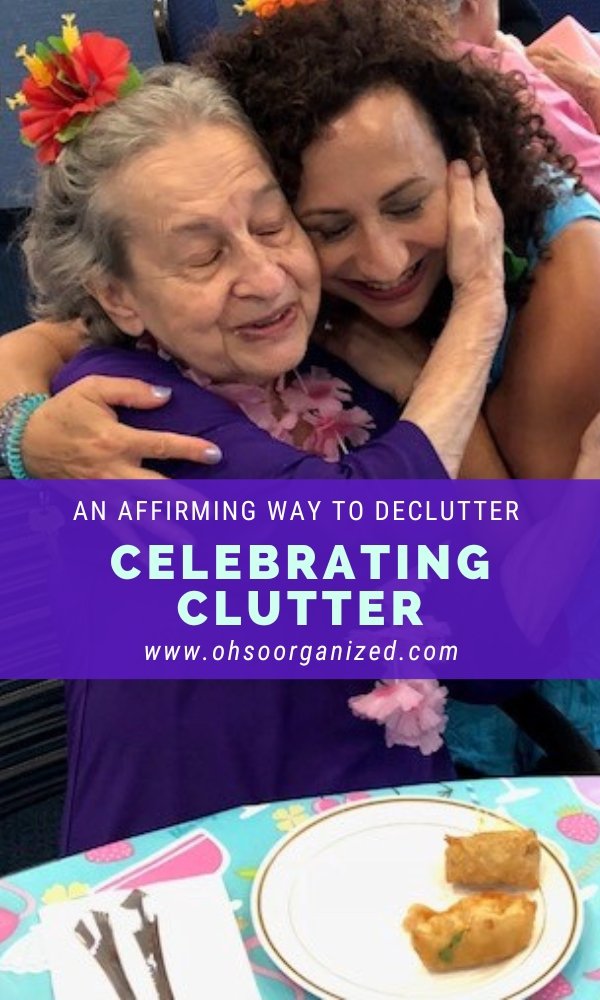
How Celebrating Clutter Can Make Surprising and Heart-Warming Outcomes

Have you ever considered celebrating clutter? Most people don’t think about it that way. We often view clutter as an overabundance of things, thoughts, or time that prevents us from living in the ways we value most.

The idea of celebrating clutter might almost seem like an oxymoron. More often, clutter feels like a burden, which can be overwhelming or paralyzing. It gets in the way and blocks forward movement.

Perhaps a better word choice is honoring instead of celebrating. What becomes possible when you approach clutter in this way? I will share a story with you to illustrate how this idea originated.


The Origin Story for Celebrating Clutter

Recently, I reread a post I wrote fifteen years ago, “As Sure as a Crocus.” Surprisingly, I found a comment (also from then) that I had never seen or responded to. I’m unsure how I missed it because I usually respond to all comments.

This message was especially poignant and heart-warming because it came from my mom, who has passed away. Seeing her signature made me smile, as she signed it with a secret name I knew was hers.

The timing of reading her words was significant for me. It was in March, the anniversary month of her birth and death. She’s been gone for four years, and I miss her terribly. As I read Mom’s sweet note of support, encouragement, and gratitude, I deeply and immediately felt her love and our connection, transcending the constructs of time and space.

How does this connect to celebrating clutter?


Why Celebrate Clutter?

Addressing the clutter in your life can be approached in many ways. One strategy is to identify and release those things that no longer belong, serve a purpose, or align with who you are now. From there, you can focus on organizing the “keepers.”

Another approach is to find the treasures and keepers first. After that step, edit those things you want to let go of.

With both strategies, you will undoubtedly make discoveries. You’ll find letters from loved ones now gone, notes with great ideas to pursue one day, children’s art, old photos, vacation memorabilia, or materials from previous careers.

These findings can evoke a range of emotions as they highlight and represent different stages and aspects of your life.

Celebrating clutter can enhance the decluttering process in several ways by gifting yourself time to:

  • Revisit and appreciate the items you’re releasing.

  • Enjoy and review some of the “treasures.”

  • Celebrate with a dance, high-fives, or cheers after a decluttering session.


Celebrating clutter can enhance the decluttering process.
— Linda Samuels, CPO-CD®, CVOP™

How Does Clutter Affect You?

Decluttering can be energizing or exhausting, depending on your mindset and situation. Approaching it with a celebratory perspective can transform your experience and make it more positive and affirming.

What is your relationship to clutter? What could celebrating clutter look like for you? I’d love to hear your thoughts. I invite you to join the conversation.


How Can I Help?

Do you want support organizing, editing, or decluttering? I’d love to help! Virtual organizing is an extraordinary path forward – Local feel with a global reach.

Please schedule a Discovery Call, email me at linda@ohsorganized.com, or call 914-271-5673. Living clutter-free is possible, especially with support.


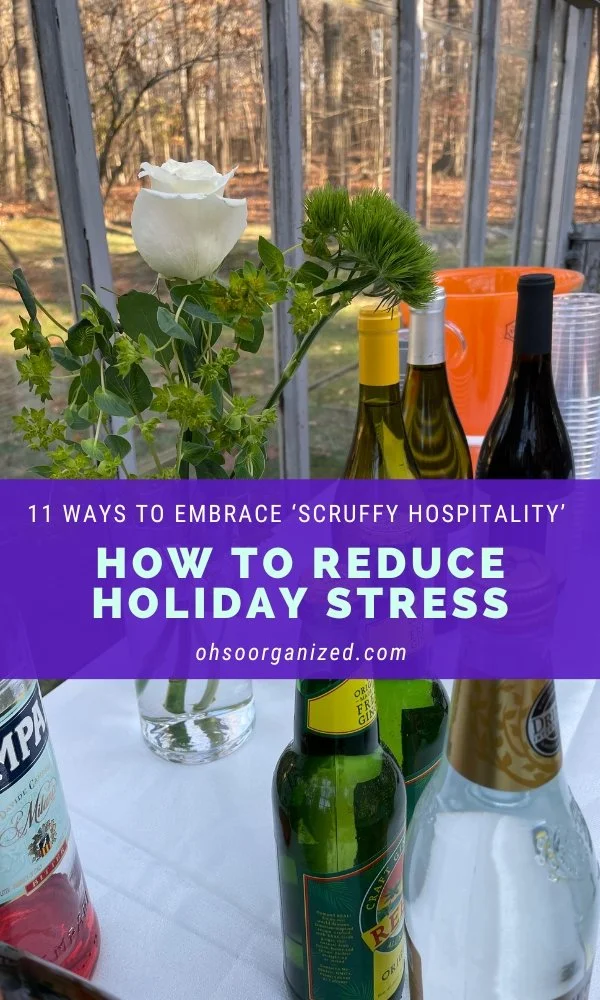
How to Easily Reduce Holiday Stress by Enjoying Scruffy Hospitality

Do you feel more stressed during the holiday season? What is the source? Holiday-related stress might revolve around travel planning, gift-giving, card-writing, decorating, over-committing, or entertaining.

As someone who enjoys and has hosted many gatherings, I continually work on reducing stress. Experience helps. The more I do something, the easier and less stressful it becomes, and the better I am at planning and navigating surprises. However, a more significant aspect is mindset. If I keep telling myself how stressed I am, what happens? I reinforce that feeling.


What is Scruffy Hospitality?

Recently, I heard about “scruffy hospitality,” which is a more relaxed approach to entertaining. It’s a practice and also a mindset. The idea is to prioritize connection and conversation over obsession with creating picture-perfect environments and Instagram-worthy meals. The concept includes having people over without cleaning up first and approaching food more simply. Instead of making elaborate dishes, ‘scruffy’ entertaining loves potlucks, leftovers, and takeout.

While “scruffy hospitality” was coined a decade ago by Jack King, an Anglican priest from Tennessee, it has received more attention in the last few years. It rejects unrealistic social media standards that create pressure on us to be “perfect hosts.” Scruffy hospitality is a nod to embracing imperfection and authenticity. These involve letting go.

For this holiday season, especially if you’re stressed, I encourage you to incorporate some ‘scruffy’ into your life. It will look different for each person. Consider how beneficial scruffy hospitality could be for reducing your stress.

As a seasoned host, ‘scruffy’ isn’t a term I naturally associate with entertaining. I like to clean and prepare. Don’t get me started on my to-do lists. I enjoy the visual aspect of decorating the tables, arranging flowers, and creating colorfully plated dishes. Those aspects aren’t stressful for me. However, those and other aspects of entertaining might be stressful for you. And if it is, some of the suggestions below can help.


11 Ways to Reduce Holiday Stress by Embracing Scruffy Hospitality

  • Reframe Clean – Do a quick clean instead of a deep one. Or hire someone else to clean.

  • Organize LessDeclutter the dining room only, leaving all other areas in their ‘as is’ state.

  • Recruit Help – Ask guests to bring parts of the meal.

  • Minimize Decor – There is no need to go wild. A single plant, a small vase of flowers, a bowl of fruit, or an arrangement of gourds is a minimalist way to decorate a table. You can also leave things bare.

  • Be Present – Cook with your guests instead of preparing things in advance.

  • Try Self-Serve – Set up your food buffet-style rather than as a plated, sit-down meal.

  • Don’t Cook – Forget about cooking anything. Purchase the entire meal or a few dishes.

  • Do Less - Simplify your menu with fewer choices or prepare dishes requiring minimal ingredients.

  • Dress Down – Be comfortable and show up as you are. No fancy clothes are required.

  • Reduce Scope – Fewer guests can make the gathering more manageable. Dial down your invite list to reflect your ideal number of guests.

  • Simplify Gift Giving – Focus on clutter-less gifts for you and the recipients. Give meaningful time-centered gifts like movie tickets, museum passes, or personal care services.


Scruffy hospitality is a nod to embracing imperfection and authenticity.
— Linda Samuels, CPO-CD®, CVOP™

How I’m Incorporating Scruffy Hospitality This Season

One thing I decided to do differently this year is not to bake the apple and pumpkin pies. Instead, our daughter generously offered to make pies. While I’ve always baked, removing the pie-baking task frees up some time and reduces stress around coordinating kitchen usage with my husband. We share cooking for Thanksgiving and work around each other’s schedules and tasks. No pie baking this year means I’ll eliminate the stress of negotiating for counter, oven, and refrigerator space.

The other area where ‘scruffy’ applies is the number of guests. We love having a houseful of family and friends for the holidays. However, some guests have health issues or scheduling conflicts this year. While we’ll miss them greatly on Thanksgiving, fewer guests give me more time to talk with people. Managing the flow of the space is less stressful with fewer people, too.


Human-Considered Holidays

The holidays don’t have to be stressful. There are many ways to increase joy and minimize stress. How can you relax your approach to holiday hospitality? What will help you make it more joy-filled and less stressful? I’d love to hear your thoughts and invite you to join the conversation.

Do you want help decluttering, organizing, brainstorming, or planning? Do you need an accountability partner? I’m here for you. Virtual organizing is an extraordinary path forward - A local feel with a global reach.

Please schedule a Discovery Call, email me at linda@ohsorganized.com, or call 914-271-5673. Organization and ease are possible, especially with support.


5 Powerful Ways Learning at an Organizing Conference Encourages Possibilities

What happens when you have so many possibilities? Do you feel overwhelmed? Do you get stuck? Are you unable to make decisions or take action? It’s terrific to have options and know there are lots of possibilities. However, when the scope is too large, the choices can feel more like a burden than an inspiration.

Last week, I attended the ICD conference near Boston with over 100 organizing colleagues from around the globe. It felt amazing to be together in person again, be with my colleagues, and meet new friends. We learned from incredible experts during seven 90-minute sessions. It was wonderful, intense, and emotional. There were sessions about dementia, hoarding, neurodiversity, ADHD, anxiety, time management, and mindset.

By the end, my brain felt drippy, like a sponge that couldn’t absorb more liquid. Of course, I want to share everything I learned with you. As I sat to write this, I got overwhelmed by the options and possibilities. So, guess what? I’m dialing it back from my 16 pages of notes to share information from five of the sessions. I hope the ideas open up something for you- a new perspective, reframe, or possibility.


5 Powerful Ways Learning Encourages Possibilities

1. DEMENTIA | “I am who I am. I’m just different.”

Beth Nolan, PhD, the Director of Research and Policy for Teepa Snow’s Positive Approach to Care™ (PAC), said there are 100+ causes and types of dementia. One way to help is to understand while dementia “robs” the person of many things, they still have skills and strengths. Identify and focus on those.

My mom was diagnosed with vascular dementia in 2013 and passed away in 2021. While many of her abilities were compromised over those eight years, I was always inspired by what remained, like her ability to make music, play the piano, sing, and express love. She was still my mom, just different.


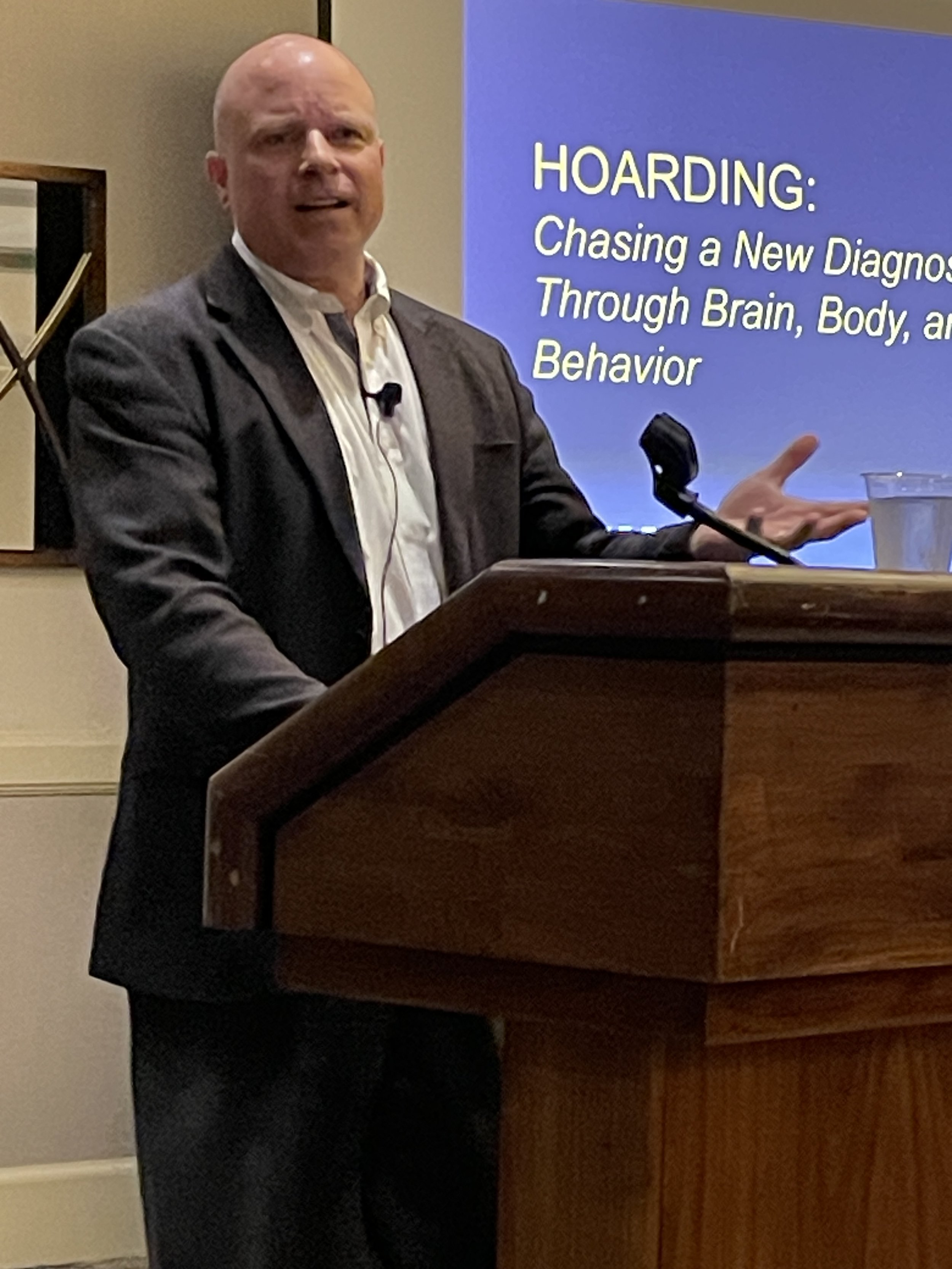
2. HOARDING | “Hoarding isn’t just a house problem. It’s a mental health problem.”

Dr. David Tolin, the Founder and Director of the Anxiety Disorders Center at the Institute for Living and Adjunct Professor of Psychiatry at Yale University School of Medicine, said Hoarding Disorder became a standalone diagnosis in the 2013 DSM-5. The hallmarks of the disorder are having difficulty discarding or parting with possessions and having a visible manifestation of clutter build up with the home no longer useable for its intended purpose.

For people with Hoarding Disorder, “Saving happens because tossing is distressing, not liberating or freeing.”

Dr. Tolin shared these statistics:

  • The drive to acquire and save affects 2-5% of the population worldwide.

  • Hoarding Disorder is twice as common as Obsessive Compulsive Disorder (OCD).

  • Hoarding Disorder begins at a young age (6-16) and worsens with age. It does not get better on its own.

While Cognitive Behavioral Therapy (CBT) is one of the most successful treatment methods for Hoarding Disorder, it is not 100% effective. Through continuing research, Dr. Tolin is committed to better understanding the psychology and biology of hoarding behavior and discovering ways to boost CBT’s efficacy.


Saving happens because tossing is distressing, not liberating or freeing.
— Dr. David Tolin


3. NEURODIVERSITY | “The value of life can’t and shouldn’t be based on productivity. It leaves a lot of people out.”

Devon Price, PhD, a social psychologist, professor, researcher, author, and proud Autistic person, was diagnosed with autism after finishing his PhD and experiencing “autistic burnout.”

Some of autism’s distinguishing characteristics include sensory input challenges, such as loud sounds and eye contact, which are painful. Processing is slower, but it’s a strength because they catch small details and are more detail-oriented. However, because the world moves fast, it doesn’t support how they process, so they feel more disabled.

Devon prefers identity-first language- “autistic person,” “autistic,” and “disabled person.” He said to avoid “differently abled” or “special needs.”


4. ADHD | “Successful ADHD women look successful on the outside and feel inadequate on the inside.”

Linda Roggli, PCC, creator of the ADHD Palooza series, a Professional Certified Coach, and author and founder of the A-D-Diva Network for ADHD women 40-and-better said she has an “ADHD brain.” 

The ADHD inattentive type is most prevalent in women. Some distinguishing factors include a busy brain, low energy, high worry, inability to concentrate, being distracted by one’s thoughts, daydreaming, difficulty following through and prioritizing, misplacing things, being talkative, impatient, having low self-esteem, not having great a working memory, making impulsive decisions, and feeling restless.

Roggli said understanding the impact of hormones on women with ADHD is essential. The brain works better with more estrogen. Estrogen affects dopamine. The ADHD brain lacks dopamine. Menopause decreases estrogen by 50% and keeps getting lower.

Most women with ADHD have comorbid conditions or “sidecars.” They include:

  • 30-40% - 1 Depressive episode

  • 50% - Learning differences

  • 10-20% Bipolar

  • 30% OCD

  • Up to 50% - Addictions


5. ANXIETY | “The more you care, the more you worry. Anxiety means I care. You can’t teach people not to care. You can only teach how to manage anxiety.”

Dr. Alicia Clark, a psychologist and author of Hack Your Anxiety, said 40% of people experience persistent stress, and only 36% get help. She also said:

  • Women suffer from anxiety 1.6 times more than men.

  • Post-pandemic, anxiety and depression increased by three times.

  • The visual distraction of clutter increases cognitive overload and decreases working memory.

Anxiety shows up in the “emotional landscape” of the organizing work we do with our clients. These can appear as fear of change, failure, facing emotional memory of things, letting go, and making mistakes.

Dr. Clark described four forms of anxiety – Whisper, Chatter, Nagging, and Yelling. She explained they are not all bad. Chatter anxiety is referred to as “good stress.” You can reframe anxiety and recognize that it drives motivation. She suggests using “anxiety to change what is in your control,” focusing on progress, reframing setbacks as part of the growth process, and getting adequate sleep.


Possibilities open up when we understand more about our psychological, emotional, and biological states. I was deeply moved by the presenters, the stories and insights they shared, and how they connected to many of my clients. It is a privilege to be part of their journey. I have the utmost respect and admiration for my clients’ determination and how they face their challenges.

What possibilities appeared for you? Did you discover any surprises? I’d love to hear your thoughts. I invite you to join the conversation.


How can I help?