Posts tagged art
How to Joyfully Lean Into a Promising “Yes” One Fresh Start Offers

The first day of this new year has come and gone. Yet that fresh-start energy lingers. I’m feeling it, especially today, as a massive winter storm blankets much of the United States with an enormous amount of snow. By tomorrow, we’re expecting 12”-16” of snow in New York. It’s giving us a giant pause, asking us to sit tight, get cozy, and weather the storm. Please stay safe, my friends.

As I sit here to write, my ‘IMAGINE’ mug filled with piping-hot coffee by my side, I’m thinking about the relationship between fresh starts and saying “yes.” I’ve noticed that, especially during this time of year, when I’m reflecting and planning, new opportunities appear. It’s not just their arrival, however. I’m in a more receptive mood, which means I’m more likely to be open and say “yes” to opportunities.

Why is that? Doing something differently or trying something new energizes me. And new changes the mood as one year ends and a new one begins. Possibilities also bring excitement and hope. Doing something different can get me out of a rut, change my perspective, or bring more joy and satisfaction. There are also serendipitous outcomes and benefits that weren’t anticipated.


Three “Yeses” Inspired by the Fresh Start

1. 20 Minutes a Day Challenge

A few of my dear friends invited me to participate in a January movement challenge. The barrier to entry was so low that saying “yes” was easy.

The instructions were simple:

  • Move 20 minutes a day, every day in January.

  • Move in some way. No pressure about the intensity or the type of activity. This could be stretching, yoga, walking, swimming, or any other movement.

  • Text each other daily about what you did or didn’t do. No judgment, only support.

The benefits: The obvious one was that I was more aware of my movement during the day, which felt good. I was less sedentary. Having accountability partners encouraged me to move, even when I didn’t feel like it. The more serendipitous benefit was how much I loved this purposeful, low-pressure daily connection, banter, humor, interaction, and encouragement with my friends.

This ‘yes’ has been such a positive experience that we decided to extend the challenge through mid-February. 


2. 21-Day Tiny Shifts Experience

Dr. Elisha Goldstein, psychologist and author, offered an intriguing program beginning in January. This was another easy “yes.” With a small investment of time and money, he would help us engage in “daily, 3-minute practices to support your nervous system and help you show up differently, one small shift at a time.”

I’m all about small shifts and changes, as it’s integral to my client work. I thought it would be beneficial to try a similar experiment for myself.

During the kickoff meeting, Elisha stressed how this experience wasn’t about “fixing what’s wrong or applying pressure.” It was about:

  • Engaging in “small, repeated moments of regulation.”

  • “Learning to recover faster and more often.”

  • Building resilience.

  • Interrupting stress loops.

  • Experimenting with “nervous system friendly practices.”

  • Understanding that it’s not just about being calm, but about helping you to show up better.

  • Being more grounded and present.

Today’s practice encouraged us to “allow a little more ease,” which is exactly what I’m going to channel today, tomorrow, and going forward. It might even become my 2026 mantra. Thank you, Elisha.

The benefits: I look forward to the daily recorded messages from Elisha, which encourage me to think, relax, and regulate my emotions. The practices are simple and doable. I’m only in the first week, but so far I’ve felt more grounded, taken needed pauses, and feel more present. I’ve been reminded of how powerful the breath is for emotional regulation, and I’ve even integrated it into some of my virtual organizing sessions. I’m also appreciating the community of participants who share their thoughts through a private platform. I enjoy reflecting and learning about what others are experiencing.

Fresh starts can be invigorating, especially when you embrace new opportunities.
— Linda Samuels, CPO-CD®, CVOP™

3. Explore Somewhere New – My wonderful husband gifted me a weekend in New York City for my birthday. He planned everything, which was a gift in itself. I always love our time together. I appreciate the simple things we do, like running errands on Saturday morning, kayaking on a lake, walking hand in hand, or sharing meals. Most of our time is spent doing everyday things.

However, for the special weekend, we did things we don’t do every day. It was so much fun. That it happened in January energized the fresh start even more. We visited the Museum of the Dog. Some of my favorite things were playing with the interactive video dog, Molly, and learning about different dog breeds. It made me miss our black lab, Norton. He was an amazing soul.

We also visited the Morgan Library, which I hadn’t been to in years. It has a gorgeous, relatively new wing attached to the historic library. I got emotional when looking at Renoir’s journals and sketches. I had a yearning to draw again like I used to. Who knows? Maybe I will rediscover my art supplies this year.

After visiting two museums, enjoying lots of yummy meals, and an unplanned visit with our kiddos, who were also visiting New York City that weekend, we went on to our next adventure. Across from Grand Central Terminal is the Summit at One Vanderbilt, an immersive art experience with panoramic views of the city. The Summit is located on the 91st-93rd floors of this eco-friendly skyscraper, one of the tallest buildings in Midtown Manhattan, completed in 2021.

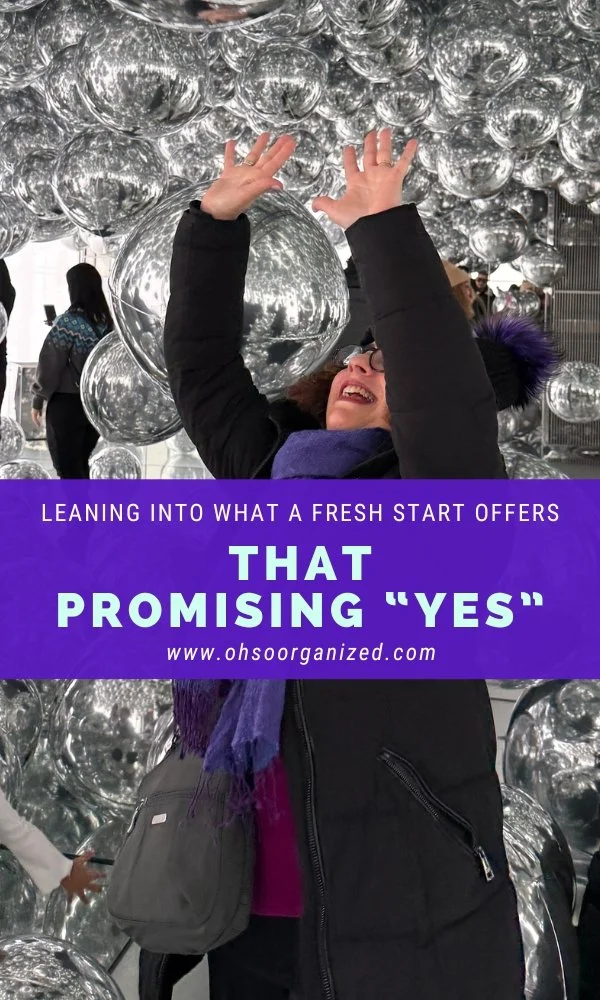
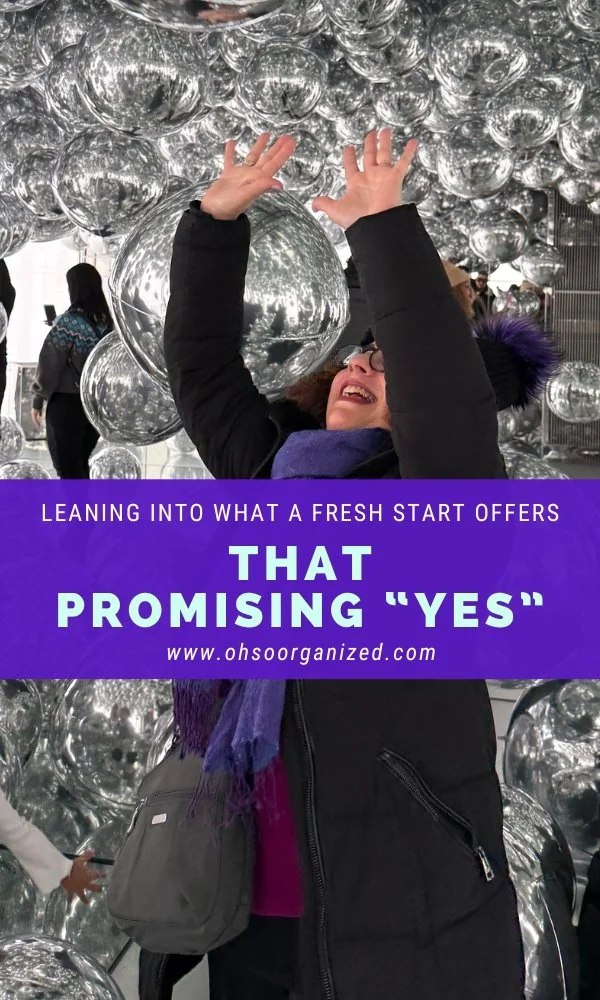
It turned out to be an overcast, cloudy day, so the views weren’t visible. It didn’t matter because there was plenty to explore. Although I would like to go again on a clear day. I loved the Affinity room, where we were surrounded by floating silver balloon-like orbs. It was so much fun catching and throwing them. I felt like a little kid.

My sense of balance and confidence was tested as I walked across mirrored glass floors. You know that wobbly feeling you get when you’re high up? I worked to accept the sensations so I could enjoy the experience.

The benefits: By the end of the weekend, I was vibrating with joy and excitement. Seeing, exploring, and doing new things was uplifting. I wanted to do that more. The weekend helped me celebrate while embracing the newness of a fresh start. The time away also reminded me of things I value: family, connection, art, presence, exploration, learning, curiosity, and experimentation.


What Will Enhance Your Fresh Start?

Fresh starts can be invigorating, especially when you embrace new opportunities. Is there something you said “yes” to this month that you’re glad you did? What have you noticed? Do these ideas resonate with you?

I’d love to hear your thoughts. I invite you to join the conversation.


How Can I Help?

Do you feel overwhelmed, disorganized, or stressed? Would you like to make changes this year? I’m here to help! Virtual organizing is an extraordinary path forward – Local feel with a global reach.

Let’s connect! I’m easy to reach.

Getting organized and making changes are possible, especially with support.


What is the Amazing Value Received by Reframing More Thoughts?

One of the treasures of being human is our capacity for thought. Ideas that visit your mind can become seeds for creating marvelous inventions or provocative works of art. Your thoughts can turn into action for self-change or positive advances in the world. Thoughts can foster compassion for people in distress or motivate you forward.

What happens when you have unhelpful thoughts? Have you ever engaged in negative self-talk, unnecessary doubt, self-sabotaging thoughts, or word loops that keep you stuck? I have and so have many of my clients. It’s not productive or helpful, but it is a common human experience.

Years ago, I traveled to Austin for an organizing conference. During one of the breaks, I walked into town and discovered this message spray-painted onto the side of a building. It said, “We don’t say fried. We say, deep sauté.” Talk about a reframe! Some of you will agree that eating fried foods isn’t the healthiest choice. Saying “deep sauté” instead doesn’t make the food more nutritious, but it immediately changes my perspective to something more positive. That is the power of the reframe.

While I’m not encouraging you to eat more fried or deep-sauteed foods, I suggest you use this concept to adjust your negative self-talk and other unproductive thoughts.

Let’s test some out.

Instead of:                                          Use:

I’ve never been organized.                 I’m learning to get organized.

My clutter is overwhelming.               I am decluttering a little bit each day.

I don’t know how to get organized.   I will reach out for organizing help.

I’m not good enough.                         I am enough.

I have so much to do.                         I get to focus on what is most important.


One of the treasures of being human is our capacity for thought.
— Linda Samuels, CPO-CD®, CVOP™

What are some of the negative, self-sabotaging thoughts you have? What are alternate reframes? Does it help you think differently by changing your perspective? Your mind can be channeled in many ways.

The next time you’re going down the adverse rabbit hole, stop. Reframe and adjust your thoughts in a more supportive direction. If you need help reframing and activating, I’m just a phone call or email away. I’d love to hear your thoughts. I invite you to reach out and/or join the conversation.


How can I help?
 
When Emotional Loss Happens in Life, Does It Make Letting Go Agonizing?
How to Be Inspired By Possibilities With Fall’s Astonishing Cues

In my life and the organizing work, I do with clients, letting go can be accompanied by loss and intense emotions. Loss can be of a loved one, a move away from a treasured home, a change in family structure, or a job.

Even when a change is something we want, letting go of what was, is inevitable. Because without letting go, we cannot move forward and remain stuck in the past. For some, letting go can be freeing. For others, the process is painful. It depends on the person and circumstance.


Letting Go Slowly

My mom died last month. I’ve been thinking a lot about the ways I’ve had to let go in these years. There has been letting go of her as her dementia worsened, along with the physical stuff that she owned. About four years ago, we moved mom from her home of almost 60 years into a memory care unit in an assisted living facility. At that time, I cleared out and sold her house. This was the home I grew up in and that our family gathered in for almost six decades. 

There was so much letting go that happened then. While the family wanted many of my parents’ belongings, there were many things they didn’t take. The leftovers were sold, recycled, donated, or discarded. We let go of the house contents and then the actual house. It was necessary, but I felt a profound loss and shift. 


More Letting Go

Packed up mom’s room

By the time I moved my mom into The Ambassador, her possessions fit into the contents of one room. She had just what she needed. No more. No less. I decorated her room before moving in so she would feel comfortable being surrounded by her favorite art, music, family photos, and piano.

After she died, I cleared out her room. It struck me how simple the process was compared to clearing out her home. The most challenging work I already did. But I noticed something interesting. While I had loving offers from my husband and kids to help pack up her room, I needed to do it myself. For me, part of letting go included touching her things one last time. I carefully packed up the framed pictures. I washed and gently folded her clothes before passing them on. For so many years, I had taken care of my mom and all of her things. I wanted to give them one last loving touch goodbye as I packed them up and routed them to family or the donation place.


Letting go requires patience, time, readiness, and space to get there.
— Linda Samuels, CPO-CD®, CVPO™


Balancing Loss

Periwinkle flowers

Grief isn’t something you get over. It’s something you live with that never entirely goes away but varies in intensity. I said earlier that one reason we let go is so we can move forward. And I get that. I believe that. But I also know that letting go requires patience, time, readiness, and space to get there. To help balance the emotions and grief, I’ve spent a lot of time these past weeks taking walks, resting, meditating, writing, talking with family and friends, getting fresh air, noticing the spring flowers, and being in the woods or near water. These help me focus on the present, reflect on the past, slowly let go, and move on. 

Some types of letting go are more energizing. This one, losing my mom and wrapping up her life, feels different. I’m being gentle with myself as I continue letting go, handle the remaining details of mom’s life, and find my way forward.

Is letting go a challenge for you? Does it feel different when it is accompanied by loss? What helps you let go? I’d love to hear your thoughts. I invite you to join the conversation.


The Art of Organizing
The Meta-Monumental Garage Sale by Martha Rosler

The Meta-Monumental Garage Sale by Martha Rosler

In the past few years, I saw two exhibits at the Museum of Modern Art (MOMA) in New York City that had organizing themes. I’ve always recognized and enjoyed the visual aspect of the organizing work that I do. These installations brought art and organizing into a new light. While the two exhibits served different purposes, present in each were themes of collecting, repurposing, preserving, and letting go.

Martha Rosler’s The Meta-Monumental Garage Sale is on view through the end of this month. She says, “An object is always more than what it is: A chair is never only a chair, a spoon never merely a spoon. It travels through social worlds, and carries forward a history, belonging first to those who produced it, and later, to those who bought, used, altered, sold, traded, or discarded it. Value is ascribed to it, value is withdrawn; value is regenerated.”

Rosler’s interactive exhibit allows you to actually participate in the Garage Sale, by physically handling the objects, bargaining with the sellers, and purchasing someone else’s discards. Similar objects are grouped together. Signs such as “Haggle,” or “Everything Clean Nothing Guaranteed,” along with real time video monitors of people shopping, encourage you to engage in the active art of acquiring. As I walked around, I could feel the buzz of others enjoying the hunt.

Waste Not by Song Dong

Waste Not by Song Dong

The other exhibit, which I saw several years ago at MOMA, was Song Dong’s piece Waste Not. It was a poignant tribute and collaboration with the artist’s mother who would not part with any of her completely filled Beijing home. With his mother’s agreement, he turned her accumulated possessions into an art project. In her culture, the art of not wasting was considered “a prerequisite for survival.” In our culture, this type of saving without any dispossession would be thought of as hoarding behavior. The installation included the complete contents of her home, amassed over fifty years. Everyday items like pots, plastic bottles, and empty toothpaste tubes were organized and displayed for viewers to walk through and see. While you couldn’t touch the objects, as in the Garage Sale, you could get close to them without any barriers.

The things we collect, save, and let go of are integral to our human experience. With these two exhibits, someone else’s letting go enabled us to reexamine these objects as art, life, and new possibilities. What are your thoughts about acquiring, saving, or letting go?